
Contributor: Taylor Lynch, MD
Educational Pearls:
What is Central Cord Syndrome (CCS)?
-
Incomplete spinal cord injury caused by trauma that compresses the center of the cord
-
More common in hyperextension injuries like falling and hitting the chin
-
Usually happens only in individuals with preexisting neck and spinal cord conditions like cervical spondylosis (age-related wear and tear of the cervical spine)
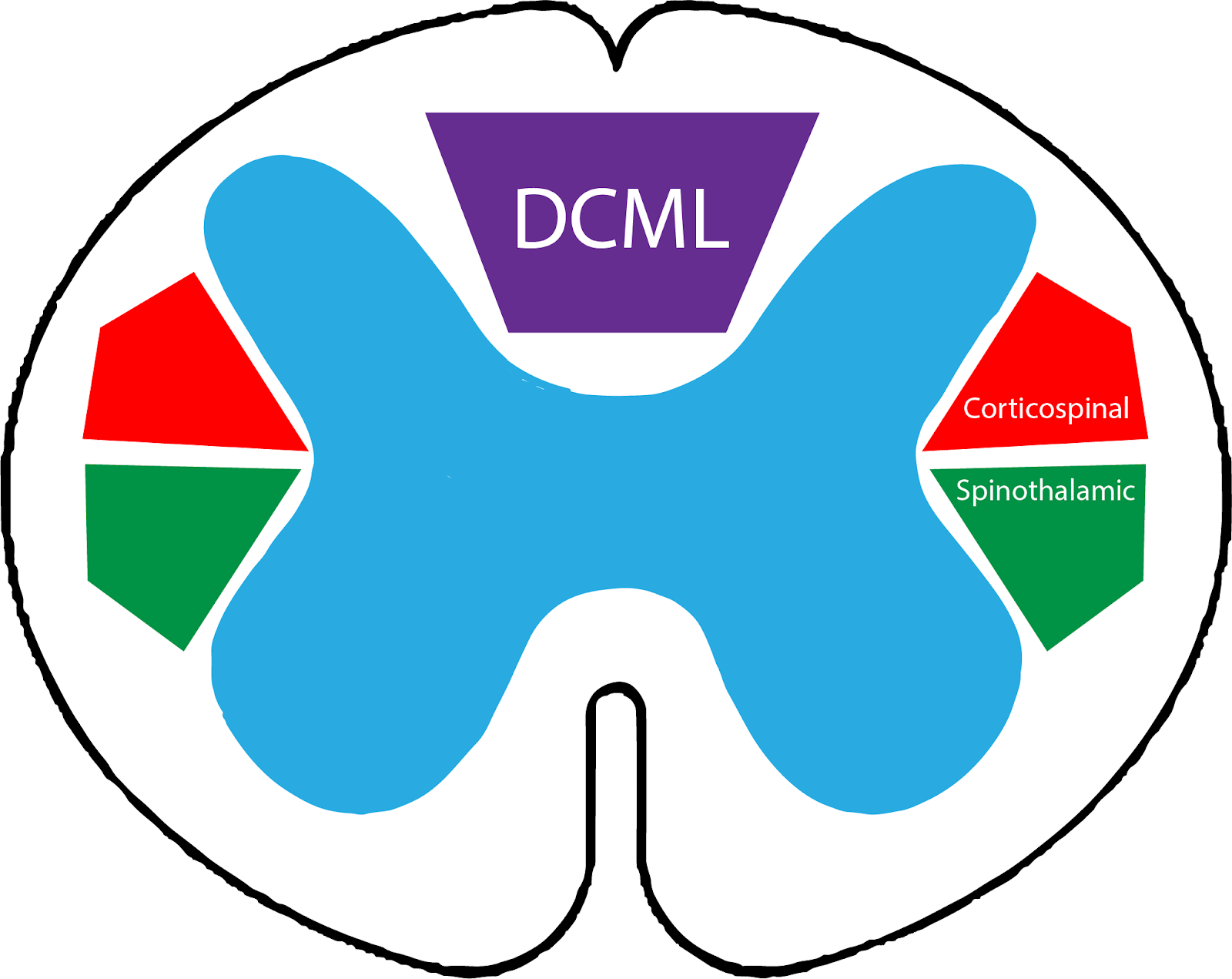
Anatomy of spinal cord
-
Motor tracts
-
The signals the brain sends for the muscles to move travel in the corticospinal tracts of the spinal cord
-
The tracts that control the upper limbs are more central than the ones that control the lower limbs
-
The tracts that control the hands are more central than the ones that control the upper arm/shoulder
-
-
Fine touch, vibration, and proprioception (body position) tracts
-
These sensations travel in separate tracts in the spinal cord than the sensation of pain and temperature
-
Their pathway is called the dorsal column-medial lemniscus (DCML) pathway
-
This information travels in the most posterior aspect of the spinal cord
-
-
Pain, crude touch, pressure, and temperature tracts
-
These sensations travel in the spinothalamic tract, which is more centrally located
-
These signals also cross one side of the body to the other within the spinal cord near the level that they enter
-
How does this anatomy affect the presentation of CCS?
-
Patients typically experience more pronounced weakness or paralysis in their upper extremities as compared to their lower extremities with their hands being weaker than more proximal muscle groups
-
Sensation of pain, crude touch, pressure, and temperature are much morelikely to be diminished while the sensation of fine touch, vibration, and proprioception are spared
What happens with reflexes?
-
Deep tendon reflexes become exaggerated in CCS
-
This is because the disruption in the corticospinal tract removes inhibitory control over reflex arcs
What happens to bladder control?
-
The neural signals that coordinate bladder emptying are disrupted, therefore patients can present with urinary retention and/or urge incontinence
What is a Babinski’s Sign?
-
When the sole of the foot is stimulated a normal response in adults is for the toes to flex downward (plantar flexion)
-
If there is an upper motor neuron injury like in CCS, the toes will flex upwards (dorsiflexion)
How is CCS diagnosed?
-
CCS is mostly a clinical diagnosis
-
These patient also need an MRI to see the extent of the damage which will show increased signal intensity within the central part of the spinal cord on T2-weighted images
How is CCS treated?
-
Strict c-spine precautions
-
Neurogenic shock precautions. Maintain a mean arterial pressure (MAP) of 85-90 to ensure profusion of the spinal cord
-
Levophed (norepinephrine bitartrate) and/or phenylephrine can be used to support their blood pressure to support spinal perfusion
-
Consider intubation for injuries above C5 (C3, 4, and 5 keep the diaphragm alive)
-
Consult neurosurgery for possible decompression surgery
-
Physical Therapy
References
-
Avila, M. J., & Hurlbert, R. J. (2021). Central Cord Syndrome Redefined. Neurosurgery clinics of North America, 32(3), 353–363. https://doi.org/10.1016/j.nec.2021.03.007
-
Brooks N. P. (2017). Central Cord Syndrome. Neurosurgery clinics of North America, 28(1), 41–47. https://doi.org/10.1016/j.nec.2016.08.002
-
Engel-Haber, E., Snider, B., & Kirshblum, S. (2023). Central cord syndrome definitions, variations and limitations. Spinal cord, 61(11), 579–586. https://doi.org/10.1038/s41393-023-00894-2
Summarized by Jeffrey Olson, MS3 | Edited by Jorge Chalit, OMSIII